


It’s a league that simultaneously worships veteran wisdom and covets youthful potential, where the average career lasts roughly 3.3 years but the oldest player is more than two decades older than the youngest. In this high-stakes environment, youth represents both hope and uncertainty—the raw talent that must quickly master the gameplay of American football to survive the league’s relentless churn.
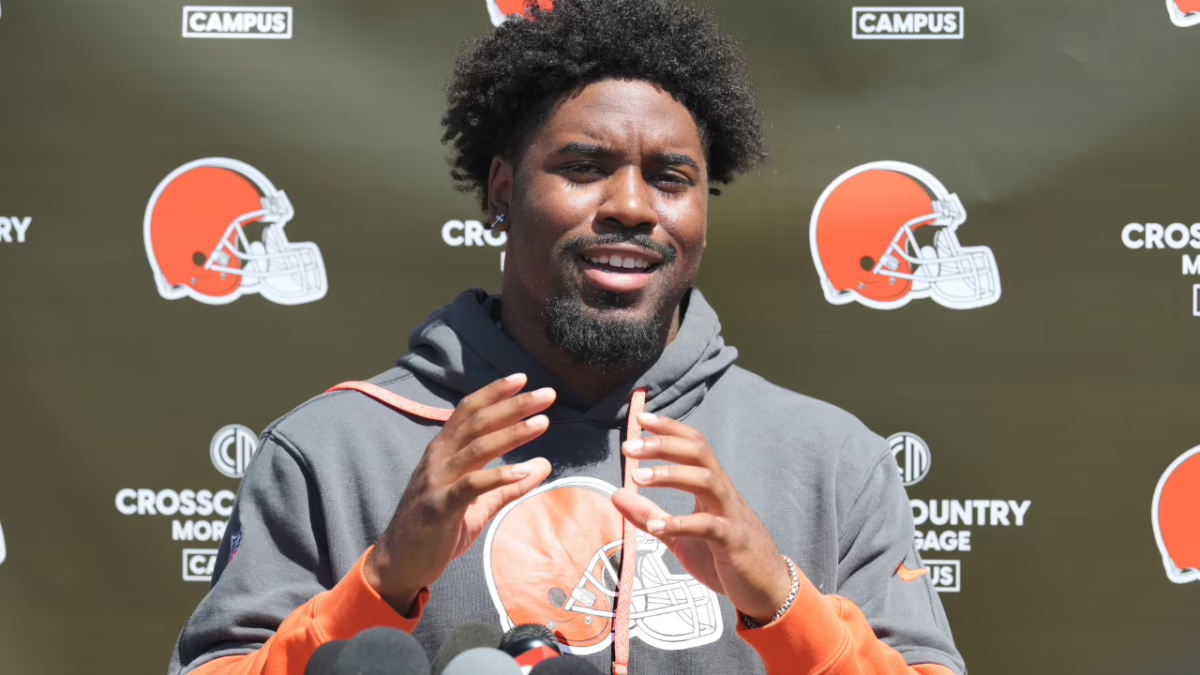
For the 2025 NFL season, that ultimate symbol of youth is Dylan Sampson, a 20-year-old running back for the Cleveland Browns who won’t turn 21 until September 14, well after the season kicks off. He stands as the youngest NFL players on active rosters, a distinction that places him at the intersection of extraordinary opportunity and immense pressure.
This article examines not just Sampson’s position as the league’s youngest but the broader context of youth in the NFL—which teams are betting hardest on young talent, how roster construction philosophies differ, and what the age trends reveal about the modern game.
The Kid in the Browns’ Backfield: Who Is Dylan Sampson?
Dylan Sampson, a fourth-round draft pick from the University of Tennessee who garnered attention for his explosive playmaking ability in college, joins as the active youngest NFL player. As of the NFL’s September 4th season opener, Sampson remains 20 years old, making him the only player from the 2025 draft class who hadn’t celebrated his 21st birthday when the regular season began.
His distinction comes with fascinating context in a league where age is constantly measured and analyzed. Sampson is approximately two decades younger than the league’s oldest player, 41-year-old quarterback Aaron Rodgers of the Pittsburgh Steelers, highlighting the remarkable age spectrum of today’s NFL . This 20-year gap represents one of the most extreme in professional sports, with players from different generations competing on the same field.
Sampson’s youth places him in rare company historically. While the record for youngest modern-era NFL player belongs to Amobi Okoye—who was just 19 when drafted by the Houston Texans in 2007—Sampson joins a prestigious list of players who entered the league at a remarkably young age. Others on that list include Tremaine Edmunds, who was 19 when drafted by the Buffalo Bills in 2018, and current stars like Danielle Hunter and Kyle Pitts, who were both 20 when their professional careers began.
The Historical Context: Youth Movement Through NFL History
The NFL has always had its young phenoms, but the parameters around youth have shifted significantly throughout league history. Jim Snyder played for the Milwaukee Badgers in 1925 when he was only 16 years old, which is very young for a player. This was long before the modern league structure came into being.
In the modern era, several notable players have made their mark at exceptionally young ages:
- Amobi Okoye (19 years, 10 months): Remains the youngest NFL player ever drafted in modern football when the Houston Texans selected him tenth overall in 2007. A native of Nigeria, Okoye had graduated from college by 19 with a degree in psychology while mastering football, a sport he didn’t begin playing until his sophomore year of high school.
- Tremaine Edmunds (19 years, 11 months): When the Buffalo Bills selected Edmunds in the first round of the 2018 draft, he became just the second teenager ever chosen in the first round. His immediate success—Pro Bowl selections in 2019 and 2020—demonstrated that youth doesn’t necessarily preclude NFL readiness.
- Danielle Hunter, just 20 years and 6 months old at the time, proved that exceptionally young draftees can excel immediately by setting records as the youngest NFL player to reach 50 career sacks and earning four Pro Bowl selections.
What makes Sampson’s situation notable in 2025 is that he joins the league amid a broader trend toward youth accumulation, particularly at certain positions where teams seek both physical primes and financial flexibility.
The Youth Contenders: Other Young NFL Players in 2025
While Sampson holds the distinction of being the very youngest, he’s far from alone in representing the NFL’s youth movement. Several other 21-year-olds entered the 2025 season as significant contributors to their teams, forming a cohort of exceptionally young professional athletes:
Key Young NFL Players for the 2025 Season
| Player | Team | Age | Position |
|---|---|---|---|
| Dylan Sampson | Cleveland Browns | 20 | Running Back |
| LeQuint Allen Jr. | Jacksonville Jaguars | 21 | Running Back |
| Nic Scourton | Carolina Panthers | 21 | Linebacker |
| Mykel Williams | San Francisco 49ers | 21 | Defensive Line |
These players represent the next wave of NFL talent, with their youth offering both potential for development and the attraction of cost-controlled contracts for their teams. LeQuint Allen Jr., drafted by the Jacksonville Jaguars, turned 21 on August 5, just before the season began. Similarly, linebacker Nic Scourton of the Carolina Panthers celebrated his 21st birthday on August 25 .
In San Francisco, defensive lineman Mykel Williams represents part of the 49ers’ significant investment in young talent, with the team potentially starting at least six players in their first or second NFL seasons. This strategy reflects a calculated risk—embracing youth while maintaining a core of established veterans.
Team Approaches: Which NFL Rosters Are Betting Biggest on Youth
Across the league, teams take dramatically different approaches to roster construction, with some aggressively pursuing youth movements while others maintain veteran-heavy lineups. For the 2025 season, the demographic divides between teams are particularly striking.
NFL Teams with Youngest Rosters for 2025 Season
| Team | Average Age | Notable Young Talent |
|---|---|---|
| Green Bay Packers | 25.23 years | Jordan Love, Multiple young receivers |
| Philadelphia Eagles | 25.49 years | Jalen Hurts (26), Saquon Barkley (27) |
| Dallas Cowboys | 25.74 years | Multiple recent draft picks |
| Cincinnati Bengals | 25.77 years | Joe Burrow (28), young supporting cast |
| Seattle Seahawks | 25.77 years | Devon Witherspoon (24), Byron Murphy II (22) |
The Green Bay Packers begin the 2025-26 season with the youngest roster in the NFL for the second consecutive year, with an average age of just 26 years, 3 months, and 2 days. Their commitment to building through the draft and developing young talent has become an organizational signature.
Meanwhile, the Philadelphia Eagles have undergone a significant youth movement themselves, jumping from 27th in youth rankings last year to 16th this season. This transformation occurred after the team lost multiple key veterans to free agency, accelerating their transition toward younger talent.
On the other hand, the Washington Commanders boast the league’s oldest roster, with an average age of 28 years, 7 months, and 4 days. The Commanders have a staggering 25 players who are 29 years of age or older, nearly four times the number on the Packers’ roster, which has just four such veterans.
Team Building Philosophies: Youth Versus Experience
The dramatic differences in roster age across the NFL reflect distinct team-building philosophies and circumstances. Teams embracing youth often benefit from financial flexibility, as players on rookie contracts provide surplus value that can be allocated to retaining star veterans or addressing multiple roster needs.
The Houston Texans exemplify the potential of strategic youth accumulation. For the third straight year, they rank first in ESPN’s assessment of under-25 talent, built around quarterback C.J. Stroud and edge rusher Will Anderson Jr.—both 24—who won Offensive and Defensive Rookie of the Year honors, respectively, in 2023 . Their talent production on cost-controlled contracts creates a championship window.
Similarly, the Seattle Seahawks have climbed to second place in the under-25 talent rankings, featuring 23-year-old receiver Jaxon Smith-Njigba, who’s coming off a breakout season, 24-year-old cornerback Devon Witherspoon, and 22-year-old defensive tackle Byron Murphy II .
However, the San Francisco 49ers present perhaps the most fascinating case study in balancing youth and veteran talent. General Manager John Lynch has expressed confidence in what he calls a “great mix” of established stars and promising young players. The 49ers could potentially start at least six players in their first or second NFL seasons in 2025, primarily on defense.
Lynch acknowledges the importance of veteran leadership in developing young talent, recalling his experience as a rookie: “I remember when I was a rookie having Hardy Nickerson next to me. So, as a young guy, you want a successful veteran who can help you on and off the field.
This ecosystem approach—where veterans mentor young players within established systems—represents one of the most sophisticated methods for integrating youth while maintaining competitive performance.
Beyond Rosters: Positional Age Trends Across the NFL
While team-level roster age provides important context, the distribution of youth across positions reveals even more about NFL valuation and career trajectories. The average age of all NFL players stands at approximately 26.6 years old, but significant variations exist between position groups.
Running back, Dylan Sampson’s position, is actually the youngest position group in the entire NFL, with an average age of just 25.45 years. This reflects the brutal physical demands of the position and the league’s increasing preference for inexpensive, replaceable talent at running back rather than investing heavily in veteran contracts.
Other notably young position groups include defensive backs (25.93 years) and wide receivers (26.03 years), both positions where speed and athleticism are at a premium and where younger players often have physical advantages over veterans who have lost a step.
At the opposite extreme, special teamers represent the oldest position groups, with long snappers averaging 30.65 years, kickers at 29.02 years, and punters at 28.51 years. These positions rely less on raw athleticism and more on technique and mental fortitude, qualities that often improve with experience.
Quarterbacks average 28.4 years old, reflecting the extended development timeline and career length for elite players at the position. The contrast between the league’s oldest position groups and its youngest highlights the different developmental curves and valuation models across specialties.
Conclusion: The Future Is Now
Dylan Sampson’s distinction as the NFL’s youngest player represents more than just a personal milestone—it symbolizes the league’s constant renewal and the inexorable push toward youth that defines roster construction. In a league where the average career lasts just over three seasons, the entrance of new talent isn’t just exciting; it’s the lifeblood of the sport.
For teams like the Packers, Texans, and Seahawks who have invested heavily in young talent, the payoff can be extended championship windows and sustained success. But as the 49ers’ approach demonstrates, the most effective models often balance promising youth with strategic veteran leadership.
As the 2025 season progresses, the focus will be on how these young players adjust to the world’s most physically demanding professional sport. For Dylan Sampson and his fellow 21-year-olds, the challenge isn’t just making an immediate impact—it’s building careers that will outlast the inevitable arrival of next year’s even younger draft class. The NFL’s relentless cycle ensures that today’s youngest NFL player will soon be tomorrow’s veteran, mentoring the next generation in a sport that never stops looking toward the future.
The “Oldest vs. Youngest” Dynamic While Dylan Sampson takes the title of the youngest, the gap between the “rookies” and the “statesmen” is widening. In 2025, the NFL continues to see legendary quarterbacks and specialists playing well into their 40s. This creates a unique locker room culture where a player like Sampson might be teammates with someone who was already in the league when Sampson was still in diapers. This mentorship—often called the “veteran tax”—is why teams like the 49ers and Steelers value older leaders even when they are actively drafting for youth.
Frequently Asked Questions
What NFL Player Has 14 Children?
former NFL MVP and Seahawks legend Shaun Alexander and his wife Valerie announced they are expecting their 14th child. The couple, known for their large and close-knit family, share their journey through their faith-based community and homeschooling initiatives.
Which NFL Player Had The Most Kids?
Antonio Cromartie is famously cited for having 14 children with eight different women. Other notable NFL “big families” include Shaun Alexander (14 children), Philip Rivers (10 children), and Travis Henry (11 children).
Can a 17-year-old Play in The NFL?
Technically, there is no “minimum age” rule, but there is an eligibility rule: a player must be at least three years removed from high school to enter the NFL Draft. Because most players graduate high school at 17 or 18, the youngest they can physically be is usually 20 or 21. Amobi Okoye remains the youngest modern player to bypass this by graduating college early and entering the league at just 19 years old.
What Age Was Tom Brady Drafted?
Tom Brady was drafted by the New England Patriots in the 2000 NFL Draft when he was 22 years old. He turned 23 shortly before his first preseason camp. His longevity is legendary, as he played until the age of 45, spanning more than two decades in the league.