


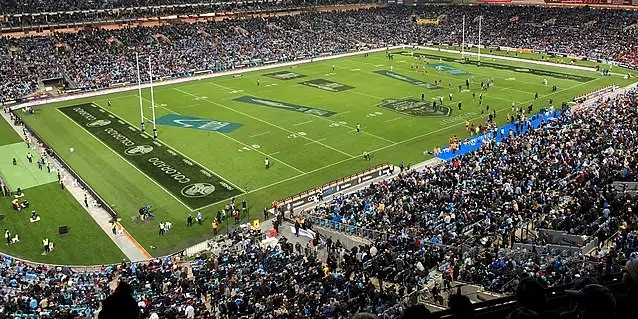
When you watch a game on Sunday afternoon or attend a high school match under the Friday night lights, you’re looking at one of the most precisely measured spaces in sports. Understanding the dimensions of the turf is essential to understanding the structure of American football. The question of how much land a football field occupies matters to school districts planning new facilities, developers converting old stadiums, and property buyers evaluating land near athletic complexes.
Football Field Acreage: The Complete Answer
A standard American football field, including both end zones, covers 1.32 acres. This measurement accounts for the playing surface that spans 360 feet in length (120 yards) and 160 feet in width (53.3 yards).
Breaking the calculation down into simpler terms: if you placed a football field on an empty lot, you’d need a rectangular piece of land measuring 57,600 square feet. Since one acre equals 43,560 square feet, dividing 57,600 by 43,560 gives us 1.32 acres.
The playing field alone, without end zones, measures exactly one acre. Each 100-yard stretch from goal line to goal line covers 48,000 square feet, which translates to 1.1 acres.
Standard Football Field Measurements Explained
The National Football League established official field dimensions that most levels of play follow. The playing surface runs 300 feet long (100 yards) with two 30-foot end zones (10 yards each) added to both ends. The width remains constant at 160 feet across all levels of professional and college play.
High school fields typically match these dimensions, though some older facilities operate with slight variations. Youth leagues sometimes use shortened fields, reducing the total acreage needed.
The white sidelines you see marking the field boundaries sit exactly at these measurements. The hash marks, numbers, and yard lines all exist within this defined space.
Quick Reference: Field Dimensions by Competition Level
| Measurement | NFL | College (NCAA) | High School |
|---|---|---|---|
| Playing Field Length | 100 yards | 100 yards | 100 yards |
| End Zone Depth (each) | 10 yards | 10 yards | 10 yards |
| Total Length | 120 yards (360 ft) | 120 yards (360 ft) | 120 yards (360 ft) |
| Field Width | 53⅓ yards (160 ft) | 53⅓ yards (160 ft) | 53⅓ yards (160 ft) |
| Total Square Feet | 57,600 sq ft | 57,600 sq ft | 57,600 sq ft |
| Total Acres (Playing Surface) | 1.32 acres | 1.32 acres | 1.32 acres |
| Hash Mark Spacing | 18 ft 6 in apart | 40 ft apart | 53 ft 4 in apart |
| Goal Post Width | 18 ft 6 in | 18 ft 6 in | 23 ft 4 in |
Comparison of NFL, College, and High School Football Fields
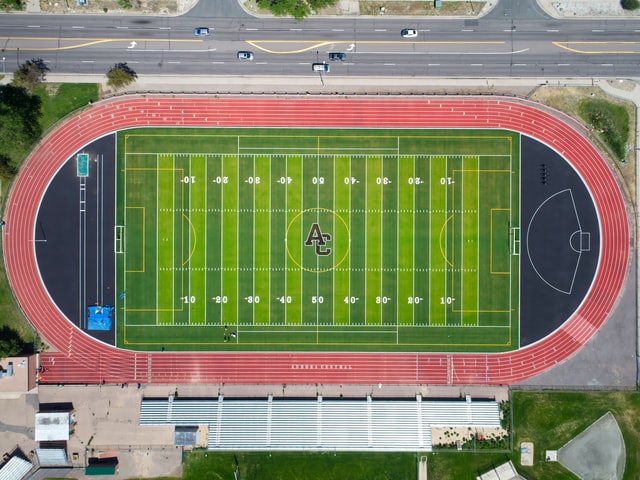
While the basic field length remains consistent across most levels of American football, important differences exist that affect gameplay and space requirements. Understanding these variations helps explain why professional games look different from college matches and why high school facilities sometimes operate under different constraints.
Playing Surface Dimensions
NFL Fields:
- Total length: 120 yards (360 feet), including end zones
- Width: 53.3 yards (160 feet)
- Playing surface area: 1.32 acres
- Hash marks positioned 18 feet 6 inches apart
- Goal posts measure 18 feet 6 inches wide
College (NCAA) Fields:
- Total length: 120 yards (360 feet), including end zones
- Width: 53.3 yards (160 feet)
- Playing surface area: 1.32 acres
- Hash marks positioned 40 feet apart
- Goal posts measure 18 feet (6 inches) wide.
High School Fields:
- Total length: 120 yards (360 feet), including end zones
- Width: 53.3 yards (160 feet)
- Playing surface area: 1.32 acres
- Hash marks positioned 53 feet 4 inches apart (full width)
- Goalposts measure 23 feet, 4 inches wide.
Facility Infrastructure Requirements
| Component | NFL | College (NCAA) | High School |
|---|---|---|---|
| Total Facility Size | 15–30+ acres | 10–25 acres | 5–12 acres |
| Stadium Capacity | 60,000–80,000+ | 20,000–100,000+ | 1,000–10,000 |
| Parking Spaces | 20,000–40,000 | 5,000–30,000 | 300–1,500 |
| Sideline Buffer | 6 ft minimum | 12 ft minimum | 12 ft minimum |
| Construction Cost | $1.5–3M | $800K–2M | $500K–1.2M |
| Parking Acreage | 10–20 acres | 5–15 acres | 2–5 acres |
| Practice Fields (typical) | 3–4 fields | 3–5 fields | 1–2 fields |
How These Differences Impact Gameplay and Planning
The hash mark positioning creates the most significant gameplay variation between levels. NFL hash marks sit much closer together than high school marks, which span the full width of the field at 53 feet 4 inches apart. College hash marks fall in the middle at 40 feet apart. Their proximity affects offensive strategy since plays starting from the hash marks have different angles and field balance depending on the level.
Wider goalposts in high school football make field goals slightly easier for developing kickers. The 23-foot 4-inch width gives younger players more margin for error compared to the 18-foot 6-inch professional standard.
Professional stadiums require substantially more land due to larger seating capacities, luxury suites, media facilities, and parking infrastructure. A typical NFL stadium complex takes up 15 to 30 acres, while a high school athletic complex only takes up 5 to 12 acres.
The sideline buffer zones affect how much additional space beyond the 1.32-acre playing surface each level needs. NFL fields maintain tighter sidelines with more equipment and personnel concentrated in smaller areas, while high school and college fields provide wider buffer zones for safety.
Total Land Requirements Beyond the Playing Surface
A functional football facility needs substantially more land than the playing surface alone. The actual property required for a complete stadium or practice field ranges from 5 to 10 acres depending on several factors.
Space-Consuming Components
Safety Buffer Zones:
- Prevent injuries from out-of-bounds plays
- Accommodate team benches and medical staff
- Provide space for officials and equipment
- Typically measure 20 to 30 feet beyond each sideline and end zone
Spectator Seating Areas:
- Modest high school bleachers require 2 to 3 additional acres
- Large college stadiums occupy 10 to 20 acres with multi-level structures
- Professional venues demand even greater footprints for luxury amenities
- Accessibility ramps and concession areas increase space needs
Parking Infrastructure:
- Represents the largest single land consumer
- High school games that draw 1,000 to 3,000 spectators need 250 to 750 spaces.
- Each parking space requires approximately 300 square feet with drive aisles
- For typical facilities, the total parking areas add two to five acres.
Practice Field Complexes:
- College programs maintain three to five practice fields
- Multi-field properties span 15 to 25 acres
- Separate practice facilities reduce wear on game-day surfaces
- Allow simultaneous training for different position groups
Football Fields Compared to Other Sports Surfaces
| Sport | Playing Surface Size | Total Acres | Comparison to Football |
|---|---|---|---|
| American Football | 120 × 53.3 yards | 1.32 acres | Base reference |
| Soccer (FIFA max) | 130 × 100 yards | 1.9 acres | 44% larger |
| Soccer (FIFA min) | 100 × 50 yards | 1.2 acres | 9% smaller |
| Baseball (with outfield) | Varies by park | 2–3 acres | 150–230% larger |
| Basketball | 94 × 50 feet | 0.11 acres | 92% smaller |
| Tennis | 78 × 36 feet | 0.17 acres | 87% smaller |
| Canadian Football | 150 × 65 yards | 1.9 acres | 44% larger |
| Arena Football | 50 × 28.3 yards | 0.3 acres | 77% smaller |
Soccer Fields:
- Size varies considerably under FIFA regulations
- Range from 1.2 to 1.9 acres depending on competition level
- Some pitches run slightly smaller than football fields
- Others exceed football field dimensions significantly
Baseball Complexes:
- Occupy irregular shapes that complicate direct comparison
- Infield square measures 90 feet on each side
- Outfield dimensions vary widely between facilities
- Complete complexes with dugouts typically use 2 to 3 acres
Basketball Courts:
- Require minimal space at roughly 4,700 square feet
- Total area equals 0.11 acres for the court alone
- Indoor facilities allow vertical space utilization
- Multiple courts fit within a single football field footprint
Tennis Facilities:
- Individual courts need about 7,200 square feet each
- Single court equals 0.17 acres
- Tennis complexes often feature multiple courts
- Four courts combined still use less space than one football field
Property Development and Real Estate Factors
Developers and municipalities face multiple challenges when allocating land for football facilities. Topography plays a role since fields require relatively flat terrain or extensive grading work. Proper drainage systems prevent water accumulation that damages turf and creates unsafe playing conditions.
Environmental and Infrastructure Considerations
Stormwater Management:
- Environmental regulations mandate drainage systems
- Retention ponds handle runoff from the playing surface
- Infrastructure can add another acre or more to requirements
- Prevents flooding in surrounding neighborhoods
Lighting Systems:
- Night games require dedicated electrical infrastructure
- Poles and transformer equipment need setbacks from property lines
- The lighting footprint remains small, but it impacts the surrounding areas.
- Modern LED systems reduce energy costs and light pollution
Property Value Effects:
- High school and small college facilities typically boost residential values
- Community amenity factors increase neighborhood appeal
- Large professional stadiums generate noise and traffic concerns
- Adjacent property prices can suffer from game-day disruptions
Construction Process and Maintenance Space Needs
Building a new football field involves disturbing more land than the final footprint suggests. Construction staging areas, equipment storage, and material stockpiles temporarily occupy surrounding space.
Surface Type Considerations
Synthetic Turf Installations:
- Gain popularity for durability and reduced maintenance needs
- An 8- to 12 inch layer of base material is required beneath the artificial surface.
- Manufacturing and transportation use petroleum-based products
- Environmental considerations extend beyond immediate acreage
Natural Grass Fields:
- Need ongoing maintenance equipment storage.
- Mowers, aerators, and machinery require 1,000 to 2,000 square feet
- Separate buildings or provide covered storage to protect equipment.
- Organic maintenance reduces chemical impacts
Climate Control Systems:
- Underground heating systems function in cold climates
- Advanced irrigation operates in dry regions
- Systems run beneath a playing surface invisibly.
- Pump houses and control stations occupy perimeter space
Historical Development of Field Standardization
Early football games occurred on fields with inconsistent dimensions. The sport evolved from rugby, which had no fixed field size. By 1912, the playing field dimensions were standardized to current measurements, though end zones didn’t become mandatory until later.
College football originally used different field widths than professional leagues. The NCAA and NFL eventually aligned on the 53.3-yard width to facilitate shared stadium use.
The acre itself traces back to medieval England, defined as the amount of land a yoke of oxen could plow in one day. This historical unit persists in American land measurement while most countries adopted the metric system.
Financial Implications for Educational Institutions
| Budget Component | Low Range | High Range | Key Factors |
|---|---|---|---|
| Field Construction | $500,000 | $2,000,000 | Site conditions, amenities |
| Natural Grass | $300,000 | $800,000 | Drainage, irrigation |
| Synthetic Turf | $800,000 | $1,500,000 | Higher upfront, lower maintenance |
| Lighting System | $200,000 | $500,000 | LED vs traditional |
| Bleachers (500 seats) | $100,000 | $250,000 | Material quality |
| Bleachers (3,000 seats) | $500,000 | $1,200,000 | Structure complexity |
| Annual Maintenance (grass) | $20,000 | $50,000 | Labor, equipment |
| Annual Maintenance (turf) | $8,000 | $15,000 | Grooming, repairs |
Construction Budget Ranges:
- School districts allocate $500,000 to $2 million for basic field construction
- Site conditions dramatically affect total costs
- Amenity levels influence budget requirements
- Synthetic turf increases upfront expenses but reduces long-term maintenance
Land Value Opportunity Costs:
- Urban schools face significant tradeoffs
- A 10-acre athletic complex in major cities represents $5 million to $20 million in foregone development
- Rural districts encounter fewer land constraints
- All districts allocate scarce capital resources to athletics
Professional Stadium Economics:
- Projects involve extensive public funding debates
- Teams negotiate public land contributions worth tens of millions
- The 2020 SoFi Stadium in Los Angeles occupies 298 acres
- Total cost reached $5 billion, including parking, retail, and mixed-use development
Alternative Football Field Configurations
| Field Type | Length | Width | Total Acres | Key Differences |
|---|---|---|---|---|
| Standard American | 120 yards | 53.3 yards | 1.32 acres | Most common format |
| Canadian Football | 150 yards | 65 yards | 1.9 acres | Larger playing area |
| Arena Football | 50 yards | 28.3 yards | 0.3 acres | Indoor configuration |
| Youth (U10) | 60 yards | 40 yards | 0.5 acres | Age-appropriate size |
| Youth (U14) | 80 yards | 45 yards | 0.7 acres | Intermediate size |
Arena Football:
- Dramatically reduces space requirements for indoor play
- Fields measure 50 yards long and 28.3 yards wide
- The total area covers only 0.3 acres.
- Existing basketball arenas host games without modifications
Canadian Football:
- Fields extend to 150 yards between goal lines
- Width measures 65 yards across
- Total area reaches 1.9 acres including end zones
- Larger dimensions create distinctly different gameplay strategies
Youth League Fields:
- Use 40- to 80-yard fields depending on age groups
- Scaled-down versions serve developmental needs
- Parks fit multiple fields in spaces for one regulation field
- Allows more children access to available land
Emerging Trends in Athletic Facility Design
Multi-Purpose Field Surfaces:
- Gain adoption to maximize land efficiency.
- Removable artificial turf panels serve multiple sports
- Same space accommodates football, soccer, and lacrosse
- Flexibility justifies the land’s dedication to athletics.
Vertical Development Integration:
- Intensifies land use around stadiums
- New professional venues incorporate retail and office towers
- Residential spaces generate revenue above parking structures
- Reduces horizontal footprint requirements
Urban Space Solutions:
- Schools build fields on rooftops in dense areas
- Elevated platforms sit above parking structures
- Engineering solutions cost more initially
- Preserves ground-level land for other uses
Climate Adaptation Strategies:
- Regions experiencing increased flooding raise the height of playing surfaces.
- Advanced drainage exceeds traditional specifications
- Drought-prone areas install sophisticated irrigation
- Future-proofing adds to initial investment
Practical Guidelines for Land Evaluation
Anyone evaluating property near football facilities should account for the complete developed footprint rather than just the playing surface. Traffic patterns on game days, lighting impacts, and noise levels extend the effective zone of influence beyond the legal property boundaries.
Considerations for Property Buyers
Former Athletic Properties:
- Typical high school complexes span 5- to 10-acre parcels
- Redevelopment potential depends on zoning regulations
- Existing infrastructure may support new uses
- Soil conditions reflect years of field maintenance practices
New Facility Planning:
- Communities benefit from understanding a 1.32-acre field as a starting point.
- Successful projects allocate land for parking and circulation
- Future expansion possibilities require advanced consideration.
- Buffer zones maintain positive neighbor relations
Reference Point for Land Measurement:
- Football fields with standardized dimensions create reliable benchmarks.
- Whether measuring backyards or evaluating development sites
- The 1.32-acre field serves as familiar reference
- Athletic competition spaces remain consistent across the American landscape.
Visual Understanding: Acreage Breakdown
| Component | Acres Required | Percentage of Total |
|---|---|---|
| Playing Surface | 1.32 | 13–26% |
| Buffer Zones | 0.5–1.0 | 5–10% |
| Bleachers/Seating | 2–3 | 20–30% |
| Parking | 2–5 | 40–50% |
| Support Facilities | 0.5–1.0 | 5–10% |
| Total (typical high school) | 6–11 acres | 100% |
The football field’s precise measurements and widespread recognition make it an invaluable tool for understanding land areas. From municipal planning to real estate transactions, knowing that a football field occupies 1.32 acres provides a tangible reference point that translates abstract acreage into something anyone can visualize. This standardization, refined over more than a century of the sport’s development, ensures consistency from youth leagues to professional stadiums while accommodating the unique needs of each competitive level.
FAQs
How many acres is a standard football field?
A football field requires a total land area of exactly 1.32 acres. This figure includes the two 10-yard end zones.
How many football fields fit in an acre?
Since a single field is 1.32 acres, approximately 0.76 of a football field fits in one acre. The football fields per acre calculation is 1\1.32
How much land is needed for a fully equipped football field?
The fully equipped football field size, including parking, seating, and facilities, can range from 10 acres to over 50 acres, depending on the level (high school vs. professional).
How big is a football field in the United States?
The size of a football field in the United States is standard: 360 feet long (which is 120 yards) by 160 feet wide (which is about 53.33 yards).